

Guide to hole plugs
All plugs fill holes, but not all holes are the same. Some are intended while others are accidental. Whatever the case, holes need to be sealed to prevent dirt, dust and moisture ingress.
In our guide to hole plugs, we'll explain what hole plugs are and cover these elements:
What are hole plugs?
Covering holes not only provides a clean finish, but also helps achieve structural integrity to ensure the application is long lasting. This is the job of a hole plug, which is typically a push plug. Plugs for holes come in different types for different functions. Some push-in hole plugs seal chassis holes and wiring outlets. Others are designed as screw-hole plugs, typically made of wood. Still others close off access holes. Hole plugs can top tube ends, or even act as protective bumpers, small appliance feet and drawer glides.
You can also get square, rectangular and round hole plugs in different materials.
What are bungs?
These are typically stoppers used to seal tubes and bottles. Often made of rubber, some have holes which enable scientists to connect different flasks with tubes. Most rubber plugs, or bungs, are tapered, though some are straight edged. Plastic bungs are also common. The plastic bung shown here is made of LDPE and is pushed into fabricated bores to provide protection and aesthetics.
Types of hole plugs
We’ll first look at plugs designed to prevent ingress of dirt, dust and moisture ingress.
Finned hole plugs
Ideal for sealing thin-walled copper tubes
Quick to fit
Features a small pull-tab for easy removal
Flange prevents plugs from being pushed into tubes
LDPE
Available in:
TPR – ideal for protecting connectors and providing a clean finish in electronic applications; stands up to acids
LDPE – perfect for protecting pipes, tubes, valves and flanges from damage and ingress during transport and storage
PVC – highly resistant to shredding
Vinyl – suited for applications where oils and grease are present
Barrel shape for snug fit forms a tight seal
Push fit for easy insertion
Flange for easy removal
Banjo union plugs
Typically used by automotive industry
Used to protect banjo unions
Flexible LDPE for snug fit
Push-in plugs for SAE & NPT threads
Threaded hole plugs
Tapered design allows each part to plug multiple diameters
Designed for plug SAE & NPT tapered threaded fittings
LDPE
Effective sealing
Ideal for postal tubes, composite containers and for plugging plastic tubing
Available with finger grips for easy insertion and removal
LDPE
Blasting plugs
Used in the mining and construction industries
Seals pipe during external blasting process
Keeps internal pipe surface clean while protecting against the impact of steel grit
LDPE
Panel plugs
Plugs for holes in metal are typically designed for closing panel cavities while providing protection from sharp edges. Push-in panel plugs also protect against dust, dirt and moisture ingress during cleaning and manufacturing processes, and they can be easily inserted and removed.
Provides a neat, finished appearance
Available in different shapes
Available in silicone, rated IP 67, with a pull tab for easy grip and removal
Also comes in nylon, PVC and TPR
Each size fits a range of panel thicknesses
Available in TPE, rated IP 67 – resists oils, acids and alkalies
Also comes in TPR and silicone for withstanding high temperatures
Similar to button plugs, providing a decorative finish
Quickly snaps into place
Ensures a secure fit for entry holes
Nylon 6/6
Excellent wire hole plugs, closing wiring or production access holes
Vents allow heat and emissions to escape
Nylon 6/6
 Plastic hole plugs: materials
Metal-hole plugs often refer to the plugs used to fill holes in sheet metal. The plug is usually plastic, although hole plugs can be made of metal. Metal plugs for holes are not commonly used but when they are, it’s usually to achieve an aesthetic effect.
Plastic plugs for holes are popular for their ease and flexibility for snapping into threaded and non-threaded holes. They’re also easy to remove. Rubber hole plugs are another option. Often rubber is referred to thermoplastic rubber, or TPR. TPR is a durable material and looks, feels and performs very much like rubber, but costs less.
Similar to TPR is thermoplastic elastomer, known as TPE. It’s often difficult to tell the two apart, but as a general rule of thumb, TPR is harder than TPE. TPE also costs less. Silicone and PVC are yet other similar materials, often used for masking processes. You can see how they all compare here:
Comparing materials
Resistance to chemicals | TPE | TPR | PVC | Silicone |
Acids | 3 | 4 | 2 | 2 |
Bases | 3 | 4 | 3 | 2 |
Hydrocarbons | 1 | 2 | 1 | 2 |
Sea water | 4 | 4 | 4 | 4 |
Water | 4 | 4 | 4 | 4 |
Max. operating temperature | 99˚C | 135˚C | 93˚C | 230˚C |
Typical cost | £££ | ££££ | ££ | £££££ |
1=Poor/ 2=Fair / 3=Good / 4=Very good
LDPE and nylon 6/6 are two of the most popular materials when it comes to plastic plugs for holes in metal – or in any material, really. These two plastics are primarily used for plugs that protect against damage and ingress.
Resistance to chemicals | Nylon 6/6 | LDPE |
Dilute acids | 1 | 4 |
Dilute alkalis | 2 | 4 |
Oils and greases | 4 | 2 (variable) |
Aromatic hydrocarbons | 4 | 1 |
Halogenated hydrocarbons | 3 (variable) | 1 |
Alcohols | 1 | 4 |
1=Poor/ 2=Fair / 3=Good / 4=Very good
Plastic plug holes: sizes
At Essentra, we stock various sizes of hole plugs and have a variety of products available to order, which are ready for shipping. To ensure you make the right choice for your application, here is a simple sizing guide.
If your plug is intended to fill a panel hole, you’ll need to take two measurements:
1. The outside diameter of the hole, as shown here
2. The thickness of the panel
You then match your measurements to the plug manufacturer’s size chart. For example, if you’re working with imperial units, and your hole’s outside diameter measures 0.625 inches, then ¾ inch plastic hole plugs will be appropriate for a snug fit.
Let’s say you want to use a domed blanking plug. Essentra Components makes it easy to select the size that you need. Let’s say your hole measures just over 0.8 inches. Note the compatible hole diameter. It matches your hole measurement. As you see in this portion of the specifications, a 1-inch hole plug will suit your needs.
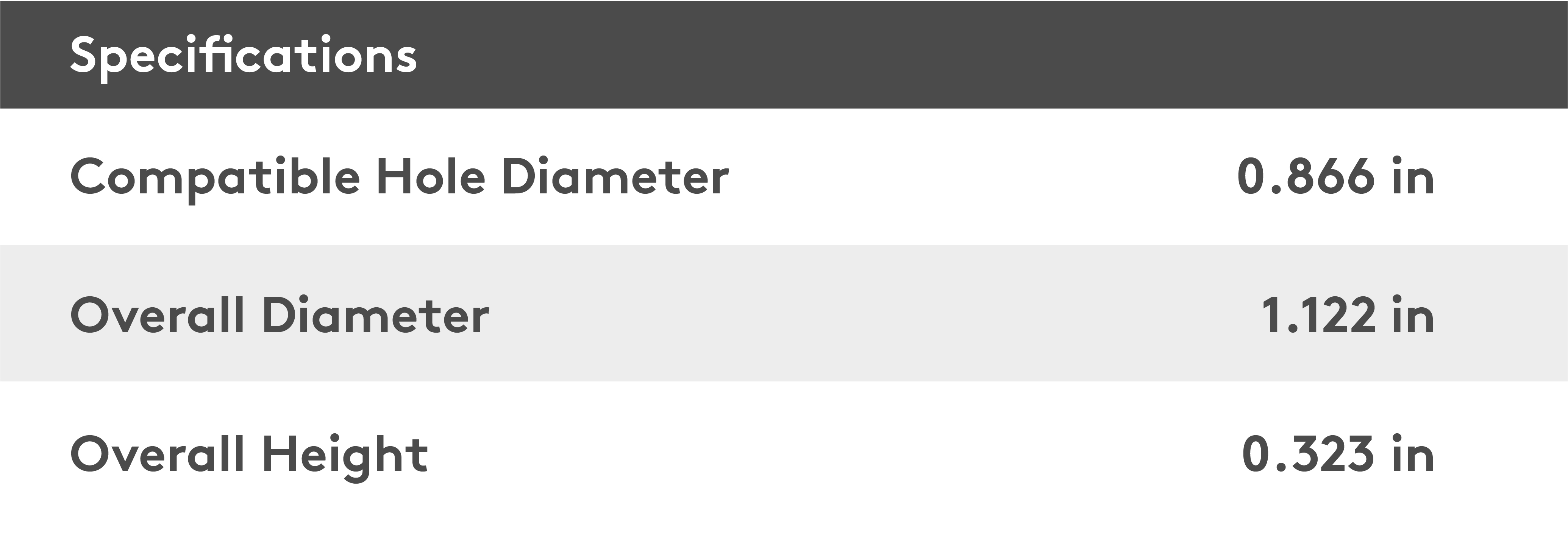 Notice that the specifications also include height, or length. Go back to your measurement for panel thickness. If the length of this plastic hole plug does not exceed the dimension given here, then this is the perfect size for you.
You also have the option to view the sizes in millimetres for metric hole plugs.
NEXT STEPS
Tell us what the component needs to do
Tell us about the application, environment, material, volume or supply requirements. We can help identify a standard product, useful guidance or a custom route.